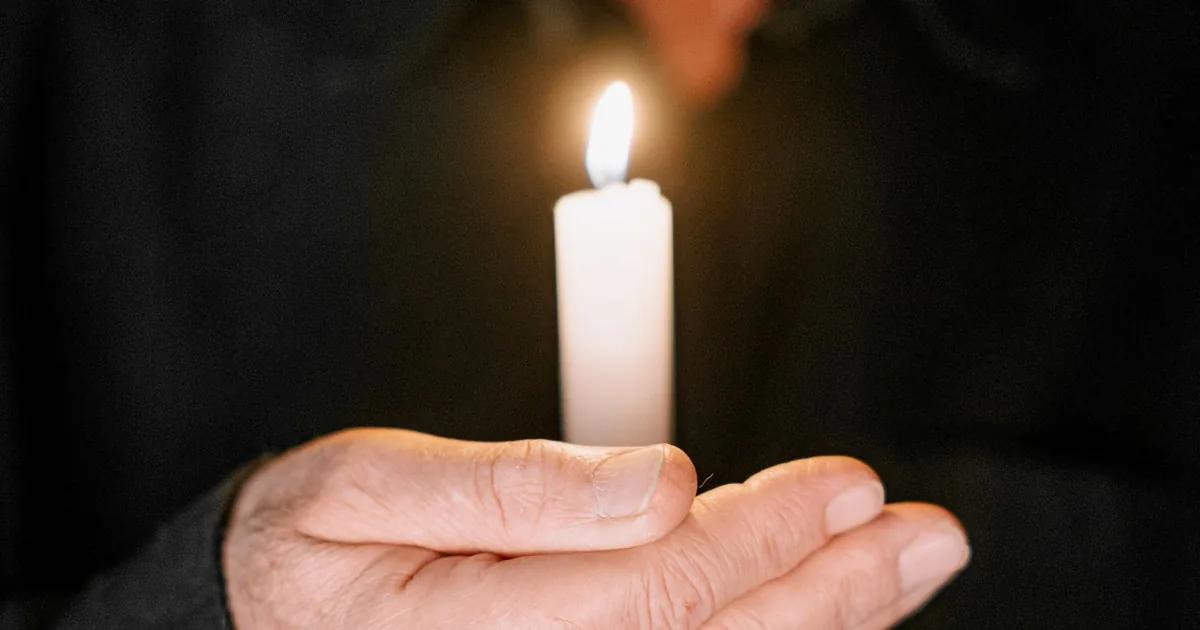
Introduction
We understand that as the first anniversary of a loved one's death draws near, the grief can open up again. The first months often pass in a blur of paperwork and errands; only as the year comes round do many people truly feel the gap that has been left. The one-year memorial (pomana de un an) — or the one-year parastas, as it is called in many places — comes at exactly this moment: a time for prayer, for almsgiving and for gathering the family around the memory of the one who has gone.
In short: the one-year memorial is held when a year has passed since the death, on the day itself or on a nearby Saturday, preferably before it. There is a service in church and, where possible, at the grave, followed, if you wish, by a memorial meal. Practice differs from one parish to another, so the final word rests with your parish priest.
Below you will find what the Church teaches and what belongs to folk custom, how to choose the date, and the days on which no memorial services are held up to September 2027. After that come what to take to church and to the grave, what to cook, including during a fast, and what is given as alms (pomană), with regional customs and guidance for other denominations.
If the first year without your loved one has been hard, the guide to the stages of grief may also help. And if you feel the need to gather your memories in one place, a memory page on Kinmory can sit alongside the traditional rites.
What the one-year memorial means in Orthodox tradition
The one-year memorial is the commemoration the Orthodox Church holds when a year has passed since a death, through a memorial service (parastas), prayer and almsgiving. According to the catechism of the Romanian Orthodox Church, it follows the example of the first Christians, who every year marked the day of a martyr's death, regarding it as their birthday into eternal life.
The liturgist Ene Braniște cites in this connection the words of Ecclesiastes: ‘the day of death is better than the day of one's birth’ (7:1). The practice is ancient: as early as the fourth century, the Apostolic Constitutions (Așezămintele Apostolice) prescribe, alongside the third, ninth and fortieth days, a commemoration when the year is completed, accompanied by alms from the belongings of the departed.
The catechism lists commemorations at 3, 9 and 40 days, at 3, 6 and 9 months, at one year and then every year up to seven years. Besides these appointed days (soroace), the departed are remembered on the Ancestors' Saturdays (Moși), at the Divine Liturgy and whenever the family wishes. You can read more about the first appointed days in the guide to the 40-day memorial service.
What the Church teaches and what belongs to folk custom
Folk beliefs have also grown up around the one-year commemoration. The table sets them apart from the Church's teaching, so that you know what belongs to faith and what to custom.
| Custom | Folk belief | What the Church says |
|---|---|---|
| The appointed days after death | The days are said to match the soul's passage through the ‘toll-houses of the air’ (vămile văzduhului) | Braniște attributes this link to ‘folk beliefs’; the year recalls the honouring of martyrs on the day of their death |
| Things given as alms | The departed is said to receive them ‘in the other world’ | Alms do not reach the departed materially; they are a prayer and a good deed done in their name |
| Sets of 6, 12 or 24 dishes | The number must be kept exactly | Church rules prescribe nothing; the number does not affect the state of the soul |
| ‘Lifting’ the mourning at one year | In the past, the heaviest mourning lasted a year | The catechism does not link the year to mourning and does not say how long mourning should last |
Sources: Ene Braniște, Liturgica specială; the catechism of the Romanian Orthodox Church; Nicolae Pintilie, doxologia.ro (2015); the Romanian Orthodox Parish of Hamburg-Harburg; S. Fl. Marian (1892).
When the one-year memorial is held and when no memorial services are held
The one-year memorial is held when a year has passed since the date of death, not of the burial: on that very day or on a nearby Saturday, preferably before it. According to the calendar of the Romanian Patriarchate (Patriarhia Română), memorial services are not held on Sundays, on the Great Feasts, between Christmas and Theophany, on weekdays in Great Lent, or from Palm Sunday to Thomas Sunday.
How the year is counted and which day to choose
The appointed days are counted ‘from the moment of death and not from the burial’, Ene Braniște makes clear, so the year comes round on the same calendar date. An example: for a death on 21 November 2025, the one-year memorial would fall on Saturday 21 November 2026, the very feast of the Entry of the Mother of God into the Temple, on which no memorial services are held. With the priest, the family may choose Saturday 14 November 2026 instead, the last day before the Nativity Fast, when the meal can still be non-fasting.
A priest answering readers' questions on doxologia.ro wrote that the one-year parastas can be held, without any worry, on one of the Saturdays closest to the date of death. Ziarul Lumina, the Patriarchate's daily newspaper, adds a nuance: better before the appointed day than after it.
The commemoration can also be held on one of the Ancestors' Saturdays (Moși); Ziarul Lumina calls the belief that it cannot be ‘mistaken’. According to the Patriarchate's calendar, the autumn Moși fall on 7 November 2026, although some parishes keep them on another Saturday nearby. In 2027, the winter Moși fall on 6 March and the summer Moși on 19 June.
Days and periods without memorial services: October 2026 – September 2027
The table helps you see in advance whether the date falls on a day when no memorial services are held. The rules are those published by the Romanian Patriarchate; the dates of the movable feasts in 2027 have been calculated by applying the same rules.
| Day or period | Dates (October 2026 – September 2027) | What you can do |
|---|---|---|
| Sundays | throughout the year | The parastas is held on the Saturday before |
| Great Feasts (praznice împărătești) | 21 November 2026 (Saturday); 2 February 2027 (Tuesday); 25 March 2027 (Thursday); 10 June 2027 (Thursday, the Ascension, when only the commemoration of the heroes is held); 21 June 2027 (Monday, Holy Trinity, the second day of Pentecost); 6 August 2027 (Friday); 8 September 2027 (Wednesday); 14 September 2027 (Tuesday) | Choose another day, preferably before the feast |
| From Christmas to Theophany | 25 December 2026 – 6 January 2027 | Hold the commemoration before Christmas or after Theophany |
| Aliturgical days (zile aliturgice) | Wednesday 10 March and Friday 12 March 2027, as well as the other days marked as such in the calendar | Choose another day |
| Weekdays in Great Lent | 15 March – 23 April 2027, Monday to Friday | Only the brief Lity for the departed (Litia mică) is read; the parastas is held on Saturday |
| From Palm Sunday to Thomas Sunday | 25 April – 9 May 2027 | Choose Lazarus Saturday (24 April 2027), the last day for memorials before Easter, or a Saturday after 9 May; confirm with the priest |
Source: calendar.patriarhia.ro — ‘Zile în care nu se săvârșesc parastase’ (Days on which memorial services are not held), ‘Zile aliturgice și zile cu diferite Liturghii’ (Aliturgical days and days with different Liturgies), ‘Nu se fac nunți (2026 și 2027)’ (No weddings); checked on 30 September 2026.
Pentecost (20 June 2027) and the Dormition of the Mother of God (15 August 2027) fall on Sundays, so they do not appear separately in the table; the feast of Pentecost does, however, continue on Monday 21 June with Holy Trinity. The catechism also lists Cheesefare Week, just before Great Lent (in 2027, 8–14 March), and the major feasts, and some parishes stop holding memorial services as early as 20 December.
The one-year memorial during a fast: what to cook and when the parastas is held
The parastas can still be held during a fast, on the permitted days; only the meal is then made with fasting food. The Patriarchate's calendar counts as fast days Wednesdays and Fridays (except in the fast-free weeks, known as ‘harți’), the Nativity Fast (15 November – 24 December), Great Lent (in 2027, 15 March – 1 May), the Fast of the Holy Apostles Peter and Paul, the Dormition Fast (in 2027, 1–14 August), as well as the Eve of Theophany (5 January), the Beheading of Saint John the Baptist (29 August) and the Exaltation of the Holy Cross (14 September).
- Nativity Fast 2026: fish is allowed on the Saturdays on which memorial services can be held — 28 November and 5, 12 and 19 December.
- Great Lent: a parastas only on Saturdays; the meal is fasting food without fish, because fish is allowed only on the Annunciation and on Palm Sunday.
- Outside the fasts, a memorial held on a Saturday can have a non-fasting meal; on Wednesdays and Fridays, fasting food is eaten.
- Cheesefare Week: no meat, but dairy, eggs and fish are allowed; according to the catechism, no memorial services are held then.
If the date has passed or you are far from home
Illness, travel or sheer exhaustion can mean that the date slips by, and there is no reason to feel guilty. When someone wrote that they had not managed to hold their mother's one-year parastas on time, a priest replied on doxologia.ro that it could be held even two months later: ‘what is essential is that it is done, because the prayers are what matter’. If you live abroad, the Romanian Orthodox parish there can serve the parastas, and the pomelnic can also be sent home.
A legal deadline that also falls at one year
For families who have not yet settled the estate, one practical point: the deadline for accepting or renouncing an inheritance is, as a rule, one year from the date of death (Civil Code — Codul civil, Article 954(1) and Article 1103(1)). The steps are explained in the guide to succession and the certificate of heir.
What is needed for the one-year parastas: at church and at the grave
For the one-year parastas you need koliva (colivă), one or more ritual loaves (colaci) or prosphora (prescuri), a bottle of wine, candles, incense and charcoal, and a list of names for commemoration (pomelnic). The parastas is usually held after the Divine Liturgy and continues with a short service at the grave. Agree the date and time with the parish priest well in advance and ask what the parish's custom is.
| What to bring | What it is for | Worth knowing |
|---|---|---|
| Koliva | It is blessed and shared among those present | The recipe is in the guide to koliva and colaci |
| Colac or prosphora | Bread brought in memory of the departed | The number depends on local custom |
| A bottle of wine | The priest pours it crosswise over the koliva and loaves or over the grave | In some areas the wine is mixed with oil |
| Candles | They are kept lit during the service | They can be handed out to those present |
| Incense and charcoal | For censing | Ask whether the parish already has them |
| The pomelnic | The names are commemorated at the Liturgy and at the parastas | Baptismal names only, in two columns: the living and the departed |
Sources: Fr Ioan Valentin Istrati (doxologia.ro, 2012); the Romanian Orthodox Parish of Hamburg-Harburg; the catechism of the Romanian Orthodox Church; Ene Braniște.
How the day of the commemoration unfolds
The day begins with the Divine Liturgy, at which the priest commemorates the names on the pomelnic. This commemoration is, as a priest quoted by basilica.ro put it, the most important thing we can do for the departed; that is why, especially at one year, it is good to hold the parastas after the Liturgy. According to the catechism, the parastas is ‘an abridgement of the funeral service’, which you can read more about in the guide to the Orthodox funeral. During the service the family stands with lit candles beside the koliva, and at ‘Memory Eternal’ (Veșnica pomenire) the relatives lift the tray of koliva and gently rock it, as a sign of their bond with the departed.
Then, where possible, the priest serves a short parastas at the grave and sprinkles it with wine poured crosswise, an old custom that, according to Braniște, recalls the spices with which the Body of the Lord was anointed. The catechism says the parastas is held at the grave ‘when possible’, so the commemoration in church is complete in itself, even without going to the cemetery.
How to write the pomelnic
Only baptismal names go on the pomelnic, in two columns: one for the living, the other for the departed. There is no need — and it is not recommended — to add notes such as ‘for the one-year commemoration’. You can also leave the priest a pomelnic for forty Liturgies (sărindar) or even for a whole year.
Talking to the priest and planning the monument
A few weeks beforehand, agree the day and time with the parish, find out whether the priest can also come to the cemetery and ask what contribution is customary; this differs from one church to another.
Many families choose to put up the permanent monument after a few months or around the time of the one-year commemoration. Check the cemetery administration's regulations and, if you wish, ask the priest to bless the cross. You can read about types and prices in the guide to funeral monuments.
Checklist, from four weeks before to the day of the commemoration
| When | What to do |
|---|---|
| 4 weeks before | Check whether the date falls on a day without memorial services or during a fast; agree the day and time with the parish |
| 2–3 weeks before | Decide where the meal will be held and how many guests to expect; let relatives know, especially those in other towns |
| One week before | Gather the things you will give as alms; order the koliva and loaves if you are not making them at home; write the pomelnic |
| 1–2 days before | Prepare the food and, if you are making it at home, the koliva; tend the grave; set aside the wine, candles and incense |
| On the day | The Liturgy and parastas, the service at the grave, the memorial meal and the giving of alms |
The memorial meal: what to cook for the one-year memorial
The memorial meal, also called praznic, follows the service and can be held at home, in the parish hall or at a restaurant. The catechism links it to the ancient agapes, the fraternal meals of the first Christians. It is not an obligation: one priest recommended it ‘if you have the means’. On fast days and during fasting periods, the meal is made with fasting food.
| Course | Non-fasting | Fasting |
|---|---|---|
| Soup | chicken ciorbă (sour soup), noodle soup | vegetable or bean ciorbă |
| Main course | sarmale (cabbage rolls) with meat, roast meat, chicken pilaf | sarmale with rice and mushrooms, vegetable stew; fish only on days when it is allowed |
| Starters and salads | salată de boeuf (Romanian potato salad), cheeses, pickles | bean dip (fasole bătută), zacuscă, aubergine salad, pickles |
| Dessert | cozonac (sweet bread), home-made cakes | fasting cozonac, fruit |
Cooking the dishes the departed loved is an old custom: at memorial meals in Moldavia, Simion Florea Marian recorded in 1892 broth with noodles (zeamă cu tocmagi), poultry borș, sarmale, meat with plums, roasts and other dishes the departed had been fond of.
The cooked food can also be taken to an orphanage or a care home or, as doxologia.ro puts it, ‘wherever we know it will be well and properly received’. And if a meal is not possible, the commemoration is no less real: prayer remains at its heart.
Customs at the memorial meal
At the memorial meal nobody says ‘Cheers’: when people drink, they say ‘Dumnezeu să-l ierte’ or ‘Dumnezeu s-o ierte’ (‘May God forgive him’ or ‘her’), and whoever receives something as alms replies ‘Dumnezeu să primească’ (‘May God accept it’), not ‘Thank you’, as the Romanian Orthodox Parish of Hamburg-Harburg reminds us. Marian recorded the same words more than a century ago in the Năsăud area. As early as the fourth century, the Apostolic Constitutions asked that people at commemorations eat in good order and in the fear of God, without drinking to excess.
Memories at the memorial meal. More often than not, someone begins a story about the loved one and the others carry it on. Some families gather these memories, photographs and messages from relatives far away in a digital memorial on Kinmory, which they open again at each commemoration. See what a memorial on Kinmory looks like
What to give at the one-year memorial: clothes, dishes and parcels
What is given at the one-year memorial varies from region to region. According to Ziarul Lumina, it is customary at 40 days and at one year to give away clothes, shoes and household items. Added to these are loaves, candles, dishes of food and parcels, both for those present and for people in need.
Clothes given as alms at one year
Clothes and shoes are given to someone who can use them: a relative, a neighbour, a person in need. What matters is that they are clean and in good condition. The priest can read over them the prayer from the Book of Needs (Molitfelnic) that blesses things given as alms. The belief that the clothes ‘reach’ the departed belongs to folk tradition; for the Church, they are alms given in the departed's name.
Dishes, loaves and parcels: how many and for whom
It is customary to hand out plates of food, cups and spoons in sets of six, twelve or twenty-four, but church rules prescribe no number, the Romanian Orthodox Parish of Hamburg-Harburg points out. The Book of Needs and the canonical sources recommend candles, koliva, loaves, wine, fruit, food and clothes as alms — ‘recommendations, not imposed regulations’, doxologia.ro stresses.
You can prepare one parcel for each person attending and a few extra; what usually goes into the parcels is described in the guide to koliva and colaci. Alms are given in moderation, and the poor, doxologia.ro reminds us, are not only those at the church door but also the sick in hospital and neighbours who need a visit.
Regional commemoration customs, recorded in 1892
The ethnographic study ‘Înmormântarea la români’ (Burial among Romanians) by Simion Florea Marian, published by the Romanian Academy in 1892, shows how widely customs varied. The table gives a few of them in modern wording; many have changed since.
| Region | What Simion Florea Marian recorded (1892) |
|---|---|
| Bukovina | At one year and in the following years, the family took a ‘tree’ (pom) and alms to church; the meal was held in the churchyard or at home, and everyone received a loaf and a candle |
| Banat (Oravița area) | Commemorations, including the one-year memorial, never went past the appointed day: they were held a day early |
| Transylvania | The memorial feast, also called ‘comând’, was held at one year too; in the Făgăraș area it was called ‘sărăcustă’, and in the Năsăud area loaves, ‘little trees’ (pomișori) or dishes were handed out |
| Wallachia (Zănoga commune, after D. Stănescu) | Alms at six months, at one year, at three years and, ‘without hesitation’, at seven years |
| Moldavia (some villages) | A service at three, six and nine months and at one year, when the koliva was taken to the grave and given to the priests |
Source: S. Fl. Marian, Înmormântarea la români. Studiu etnografic, Bucharest, Romanian Academy, 1892, ch. XXVII, pp. 369–375.
According to the DEX dictionary, the pom — a branch decorated with fruit and pretzels — belongs mainly to the burial of unmarried people; Marian recorded it specifically for the one-year commemoration in Bukovina, and small trees and ‘pomișori’ also appeared at memorial feasts in Transylvania (around Sibiu and in the Năsăud area). For today's customs, ask the older members of the family and the priest.
The one-year commemoration among Catholics, Protestants and non-religious families
Not every family in Romania is Orthodox, and remembrance takes other forms that are just as natural. Roman Catholics can request a Mass for the deceased on the first anniversary of the death, Greek Catholics serve the parastas, Reformed Christians remember the departed with honour but do not pray for them, and non-religious families gather at home or at the grave.
In the 2021 census, among those who answered the question on religion, 85.5% declared themselves Orthodox, 4.5% Roman Catholic, 3.0% Reformed and 0.7% Greek Catholic (National Institute of Statistics — INS, final results).
- Roman Catholics. The General Instruction of the Roman Missal (Institutio Generalis Missalis Romani, no. 381) counts the first anniversary of a death among the occasions for a Mass for the dead.
- Greek Catholics. The Romanian Church United with Rome, Greek-Catholic, serves the Byzantine-rite parastas, including at six months and at one year.
- Reformed Christians and other Protestants. The Reformed Church does not pray for the dead; the Second Helvetic Confession, adopted by the Reformed Church in Romania, asks that the departed be remembered with honour and that the bereaved family be surrounded with care. In other Protestant churches practice varies; the pastor can tell you what is customary.
- Non-religious or mixed families. A gathering at home, a visit to the grave, a donation in the name of the one who has gone or an evening of shared memories are equally dignified ways of remembering. In mixed families, the church service and a gathering open to everyone can sit side by side.
Frequently Asked Questions
How long before the anniversary can the one-year memorial be held?
There is no fixed rule. The one-year memorial is usually held on the anniversary of the death itself or on one of the Saturdays around it, preferably before. If the date falls in a period when no memorial services are held, the commemoration is normally moved earlier or, sometimes, to just after that period, on the priest's advice. And if the day has already gone by, the parastas can still be held later.
Can the one-year parastas be held on a Sunday?
According to the calendar of the Romanian Patriarchate, memorial services are not held on Sundays, the joyful day of the Resurrection. So when the anniversary falls on a Sunday, the parastas is usually held on the Saturday before, the day set aside for commemorating the departed. Some parishes have other customs, so agree the date with your parish priest.
What is needed for the one-year parastas?
For the one-year parastas, families prepare koliva, one or more ritual loaves (colaci) or prosphora, a bottle of wine, candles, incense and charcoal, and a pomelnic, the list of the baptismal names of the departed. The parastas is preferably held after the Divine Liturgy, and the family then goes on to the grave. Ask the priest in good time what else is customary in the parish.
How many parcels are needed for the 1-year pomana?
The Church sets no number of parcels, dishes or loaves: sets of 6, 12 or 24 are a matter of custom, not of church rule. You can prepare one parcel for each person attending and a few extra for neighbours, the sick or people living alone. What matters is that the alms reach those who need them.
What if the one-year memorial falls during a fast?
The parastas can still be held during a fast, on the permitted days; the memorial meal is then made with fasting food. In Great Lent, memorial services are held only on Saturdays: on weekdays only the brief Lity for the departed is read, and none are held on Sundays. In the Nativity Fast, fish is allowed on the Saturdays between 21 November and 20 December; in 2026, memorial services can be held on 28 November and on 5, 12 and 19 December.
What do you say when you receive alms?
When you receive alms, you do not say ‘Thank you’ but ‘Dumnezeu să primească’ (‘May God accept it’) or ‘Bogdaproste’, a word the DEX dictionary defines as thanks to the person giving alms. At the memorial meal, instead of ‘Cheers’, people say ‘Dumnezeu să-l ierte’ or ‘Dumnezeu s-o ierte’ (‘May God forgive him’ or ‘her’). These are formulas handed down by tradition, not rules of the church service.
Can the one-year memorial be held abroad?
Yes. Romanian Orthodox parishes abroad serve the parastas in the same order as in Romania, so the commemoration can be held where you live, by arrangement with the priest. The pomelnic can also be sent to the parish back home, and relatives in Romania can visit the grave; alms can be given anywhere, to those in need.
Summary
- The date: the year is counted from the death, not the burial; the parastas is held on that day or on a nearby Saturday, preferably before it.
- No memorial services: on Sundays, the Great Feasts, weekdays in Great Lent, aliturgical days, from Palm Sunday to Thomas Sunday and from Christmas to Theophany; note 21 November 2026 in particular.
- What to bring: koliva, a colac or prosphora, wine, candles, incense and charcoal, the pomelnic.
- The memorial meal is not obligatory; it is made with non-fasting or fasting food, depending on the calendar.
- The alms: clothes, dishes, loaves and parcels, with no set number, given in moderation.
- Other denominations have their own forms of commemoration, just as dignified.
- If the date has passed, the commemoration can still be held later; ask your parish priest.
Sources and notes
- Calendar of the Romanian Patriarchate (calendar.patriarhia.ro) — the days without memorial services, the fasts and the dates for 2026 and 2027.
- The catechism Învățătură de credință creștină ortodoxă (mitropolia-ro.de) and Fr Prof. Ene Braniște, Liturgica specială (doxologia.ro) — the appointed days and their meaning, the parastas, folk beliefs, the wine at the grave.
- doxologia.ro — answers from the priests Ioan Valentin Istrati (2012) and Andrei Atudori (2014, 2017) and articles on almsgiving; Ziarul Lumina and basilica.ro — the date of the parastas, the gifts, the pomelnic; the Romanian Orthodox Parish of Hamburg-Harburg — the offerings and the words said at the memorial meal.
- S. Fl. Marian, Înmormântarea la români, 1892 (archive.org) — regional customs and the one-year mourning; the Apostolic Constitutions, Book VIII, chapters 42 and 44.
- General Instruction of the Roman Missal (Institutio Generalis Missalis Romani), no. 381 (vatican.va); the Second Helvetic Confession, ch. XXVI; Agerpres and Alba24 (2026) — the Greek-Catholic parastas at six months and at one year.
- INS, 2021 Census, final results (recensamantromania.ro); Civil Code, Articles 954 and 1103 (legislatie.just.ro); DEX (dexonline.ro).
The information is current as of 30 September 2026. Customs differ from one parish to another, and the 2027 dates have been calculated according to the rules of the Orthodox calendar: confirm the date and the order of service with your parish priest and in the official calendar of the Romanian Patriarchate. This article is for information only and does not replace the priest's guidance. The note on the inheritance deadline is not legal advice; for the succession, consult a public notary (notar public).
Related Articles
- The 40-day memorial service — the commemoration closest to the funeral and how to arrange it.
- The 9-day memorial service — the order of the first commemorations after a death.
- Koliva and colaci at the parastas — the recipe and what goes into the alms parcels.
- Moșii and Ancestors' Saturday 2026 — the days of general commemoration of the departed.
- The grieving process: stages and support — what is natural in grief, including on anniversaries.
- Funeral monuments: types and prices — how to choose the cross or monument.