This article was prepared by the Kinmory team, which owns Repaus. We share practical advice for a family archive and explain how our service can help preserve memories.
How to start a Romanian family archive
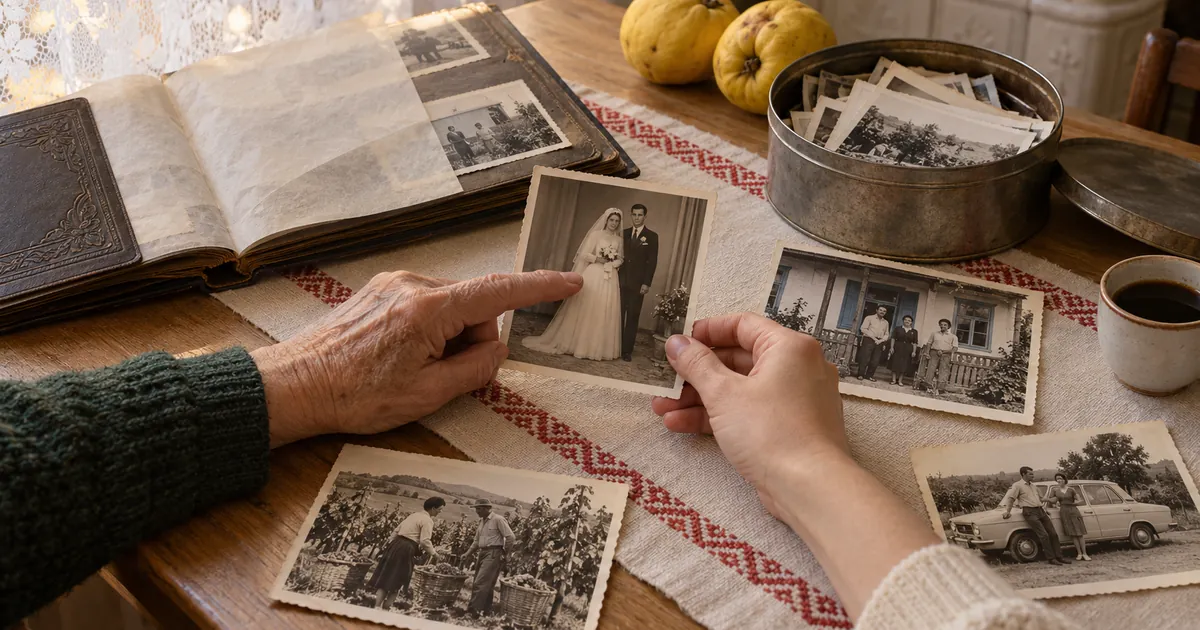
A Romanian family archive can begin with an album, a few names and a conversation. You do not need to trace every generation before organising your photographs. Choose a small part of the collection and write down what you already know: who appears, where the photograph was taken and who might remember more.
This guide is for families in Romania and relatives living elsewhere. One person may have the albums, another may recognise the faces, and someone else may keep the letters. You can bring their contributions together while leaving the originals in their existing homes. Start with a manageable task, such as describing one album page together.
The person organising the archive does not have to be a historian or a computer specialist. What matters is keeping the image, its explanation and the source of that explanation connected. A memory can remain approximate. A photograph can remain undated until another clue becomes available.
What to keep and explain
Keep the material and its story together. A portrait becomes easier to understand when it has a name, a family relationship and a few words about the occasion. Begin with things your relatives would like to revisit, rather than trying to catalogue every object in the house.
| Material | A useful action | What it tells the family |
|---|---|---|
| Photographs and albums | Copy the whole page, then individual pictures and their backs | Who appears and how the photographs were grouped |
| Letters and postcards | Keep the envelope and transcribe agreed passages | How people spoke and what they shared |
| Recorded recollections | Ask permission and note the speaker and recording date | A person's voice, expressions and perspective |
| Notebooks, recipes and notes | Photograph selected pages and explain who owned them | Interests, habits and ordinary life at home |
| Personal documents | Make a separate inventory with restricted access | Names and dates that help check family accounts |
Give each item a simple reference, such as 'album-A-01'. Use the same reference in the list of captions and the file name. A relative can then correct a name without having to describe 'the little photograph beside the one of the garden' each time.
There is no need to publish everything you collect. Separate material for family viewing, personal documents and a selection suitable for a wider audience. Keep a note of those choices with the inventory so that another person helping with the archive can follow them.
Six steps for gathering photographs and stories
Work through a small collection, listen to a story, add descriptions, make copies and check access. These steps can take place over several visits. A useful first result is a handful of explained photographs and a copy that another family member can find and open.
1. Choose one album or envelope
Photograph the album before rearranging its contents. Pictures placed together may help explain a journey or a family gathering. Record who holds the original and who passed it on. Leave glued photographs attached. Ask a conservation specialist about fragile paper, mould or pictures that are difficult to remove.
2. Listen to one story
Ask who appears, what was happening that day and what the speaker remembers about the place. Before recording, ask permission and agree who may listen. A short conversation is enough. If a question feels uncomfortable, move to something else or stop recording.
Repeat unfamiliar names to check that you heard them correctly. Ask how they were written and what the person was called at home. You can keep different accounts of an event, each attributed to its speaker, without immediately deciding which is definitive.
3. Write captions that can be checked
List the people from left to right, the place, the occasion and the year if known. Use 'approximately' or 'as remembered by…' for an estimate. Note whether the information comes from the back of the photograph, a document or a conversation. Keep a guess clearly identified as a guess.
Store descriptions in a separate file linked to the photograph's reference. Avoid writing on the picture with a pen or attaching adhesive labels to the original. If a person is unidentified, describe their position in the frame and leave space to add a name later.
4. Digitising photographs on both sides
A flat, undamaged photograph can be scanned or copied with a phone. Place it on a clean surface in even light. Hold the phone parallel to the picture, keeping hand shadows away from it. Include every edge and copy the back separately, even if it contains only a small note.
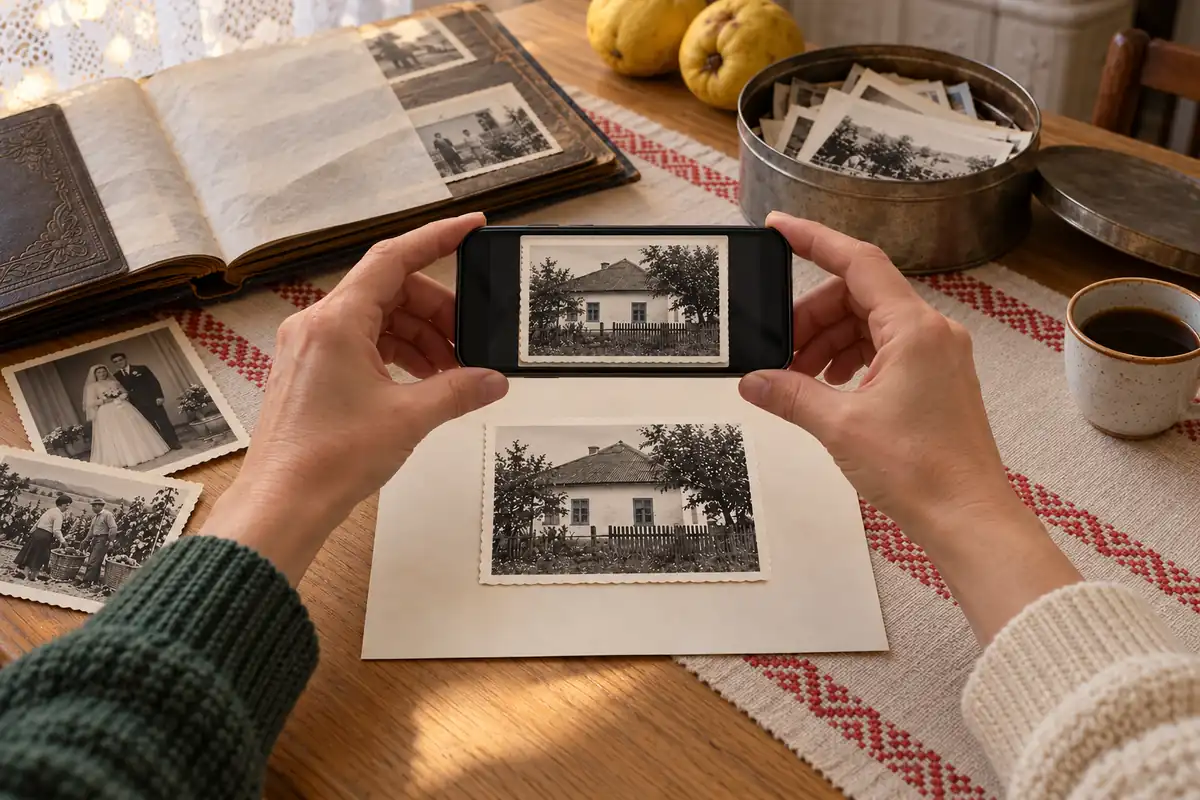
Enlarge the copy to check faces and handwriting. Keep the initial file, saving cropped or brightness-adjusted versions separately. If you use automatic restoration, label the result accordingly. Generated details do not establish what a person looked like or what an inscription originally said.
5. Connect the files to a short account
Group images by album, person or occasion, using a rule the family understands. Add a text file with names, places and sources. For an initial outline of relationships, draw the generations on paper. Mark information that still needs checking.
Send relatives a copy at its original size, rather than relying on a reduced picture in a conversation. Ask them to identify additions by photograph reference. Our guide to writing an obituary can help organise a short life story, while personal details can remain within the home archive.
6. Make a second copy and try using it
Choose another storage device or a copy held by a trusted relative. Include the inventory as well as the images. Ask someone to find a photograph by the person's name and open a recording. If the explanations are insufficient, improve them before adding the next album.
Names and memories in families connected with Romania
Preserve names and stories as the family received them, adding explanations alongside. An album from Romania may contain several languages, historical place names and different traditions. The aim is to help relatives understand these details while keeping the original wording available.
More than one language, the same person
Transcribe an inscription first. Add a translation, the name used within the family and the present place name if the identification is reliable. Preserve diacritics. Similar names alone do not establish a family relationship. Compare places, dates and other documents before combining two records.
A relative abroad may find it easier to contribute in another language. Keep their original account and its translation separately, naming the translator. A short explanation of a family expression can be more useful than a literal translation.
A pomelnic and a family notebook
In the Orthodox explanation published by Doxologia, a pomelnic lists baptismal names for remembrance in church. A family notebook can also record full names, relationships and stories.
They serve different purposes. Do not assume that relatives share a religious tradition. Orthodox, Catholic, Greek Catholic, Reformed, Unitarian and secular families can organise their memories according to their preferences. If stories are gathered around a commemoration, keep arrangements for a first-anniversary parastas, an Orthodox memorial service, separate from the work of describing an album.
Looking for information in archives
For civil registration registers, Annex 6 of Romania's National Archives Law No. 16/1996 specifies access for research after 100 years from creation.
Prepare the locality, an approximate period and name variants before asking the institution holding the records. Check the conditions for the particular register. Record an unsuccessful search with the source consulted and the date. An unanswered search is not a conclusion about your family.
Where to keep the archive and who can see it
Combine an easy browsing format with original files stored in two independent places. An album, a digital folder and a memorial page serve different purposes. Choose what suits your family and write a short access note to accompany each copy.
| Format | Access | Useful for | How to look after it |
|---|---|---|---|
| Paper album | People you show it to | Browsing and talking together | A dry place away from sunlight, plus digital copies |
| Files on a home device | The holder and people receiving copies | Original images, recordings and documents | Another copy on a separate device and periodic checks |
| Shared remote folder | Relatives with access rights | Contributions from different cities and countries | Naming rules, a responsible person and a separate copy |
| Printed album for relatives | Recipients of the copies | An explained family selection | Keep the files used for printing |
| Memorial page | The audience selected in its settings | A portrait, photographs and a life story | Keep original materials in the family archive and check access |
In a note called 'How to use the archive', explain where originals are kept, who adds descriptions and which materials remain private. Keep passwords out of a folder shared with everyone. Use each account's own access and recovery options according to its rules.
Maintain a simple record of changes: which photograph received a new caption, who confirmed a name and when a copy was updated. This helps people receiving the collection recognise its recent version.
Making room for your own story
You can add your own memories too: a route to school, a recipe, a trade or the shape of an ordinary day. Write for someone unfamiliar with the people and places. Explain who 'Aunt Maria' was and what the family meant by its name for the grandparents' house.
Choose a photograph and describe what happened beyond the frame. Distinguish what you remember directly from what you learnt later. Leave room for additions without making the account a form that must be completed. A short recording can be transcribed whenever convenient.
Before sharing photographs and accounts involving other people, agree what can be shown and to whom. For children, discuss this with a parent or legal representative and consider the child's comfort. A family selection can remain within a small circle. If publication is disputed, keep the material in the private collection while the question is resolved.
How Kinmory can help
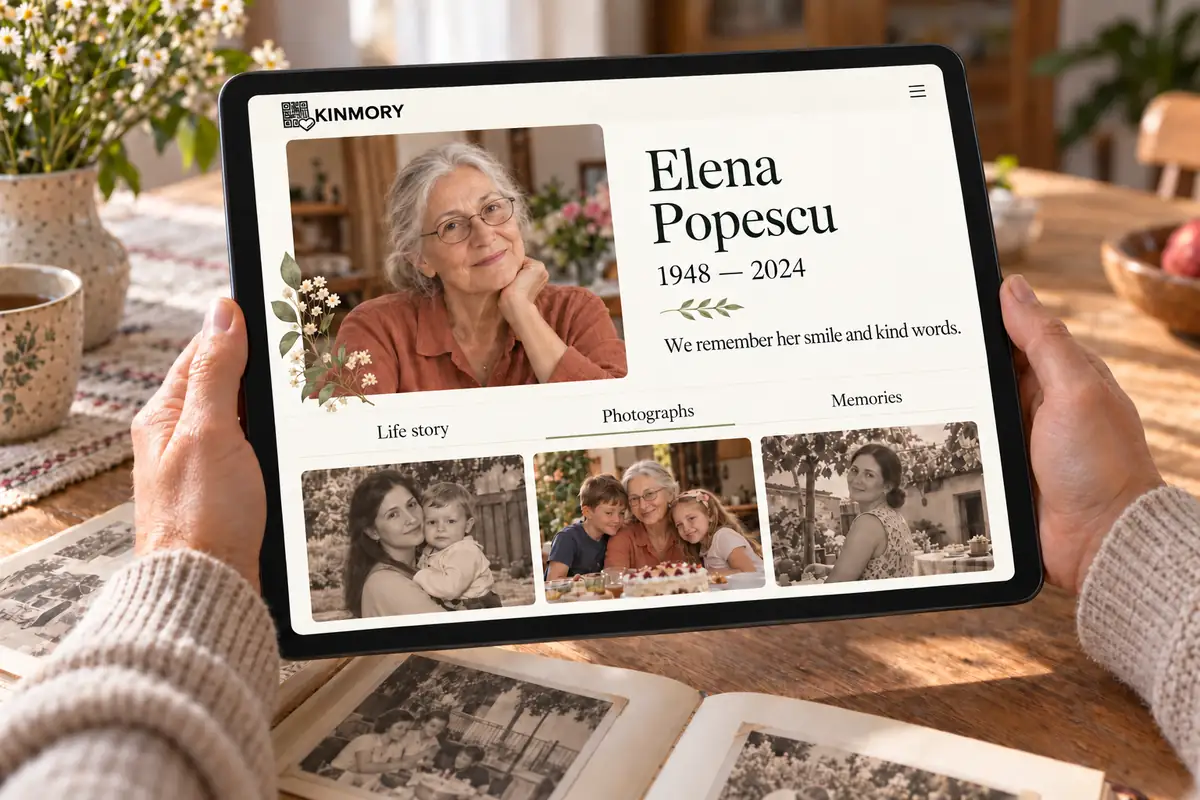
Kinmory brings a portrait, photographs and a life story together on a memorial page that you can share with people close to you. Explore the possibilities on the service's home page.
We plan to develop ways to preserve your own memorial page, create photo albums and family trees, and write memoirs. These are team plans, separate from the photographs and life story you can already add to a memorial page.
A portrait, photographs and a story
Start with a portrait, a few captioned images and an episode that conveys something about the person. Choose a presentation that reflects how you remember them. Add your own words, their interests and the moments your family wishes to share.
The guest book allows relatives and friends to leave memories. Choose participation settings when creating the page and agree which materials the family will prepare together. You can assemble and preview the page before making payment when publishing it.
Access and relatives' contributions
Choose a public page, password access or closed viewing for invited people. Search engines may find a public page. Public and password-protected pages undergo moderation, including after editing or switching to those modes. Share the link and QR code once that review is complete.
Invited people use their own accounts for closed viewing and editing. Working on the page together depends on the chosen plan, as does adding video. Agree who will add photographs and who will check captions. The author remains the page owner, while invitees contribute within their assigned rights.
A QR code and your original materials
A QR code can connect the page with a plaque at a place of remembrance. You can download it to prepare a plaque, and ask the Kinmory team about production, ordering and receiving it. Before installation, check the site's rules with the administrator or parish. Test the code on a phone and retain the page address.
The page is created without a set expiry date and can be added to over time. Keep original images and texts in two independent places within your family archive as well. Voice recordings and documents can remain in the family folder, while the page presents the photographs and stories agreed with those involved.
Explore Kinmory's options and choose the photographs and memories with which you would like to start your page.
Frequently asked questions
Where should I start if I have many photographs?
Choose one album or envelope. Photograph the existing arrangement, number the images and describe a few with a relative's help. Keep the originals in place and make a second copy of both the files and their explanations.
How should I record an uncertain name or date?
Use 'approximately', 'possibly' or 'as remembered by…' and identify the source. Keep the original inscription alongside its translation. If accounts differ, record them separately until a document or confirmation helps clarify the detail.
Can I keep the stories within the family?
Yes. Choose the materials and who can view them, ask permission before recording or sharing an account and note the agreed limits. Personal documents and photographs of children can remain in a folder with restricted access.
Who can see a page created with Kinmory?
In Kinmory, you choose public access, password access or closed viewing for invited people with their own accounts. Public and password modes require moderation, repeated after editing or switching to those modes. Share the link and QR code after review. Search engines may find a public page.
How should I keep the materials used on a memorial page?
A Kinmory page is created without a set expiry date and can be added to. Keep original photographs, captions and texts separately in two independent places. These copies can help you prepare a printed album, a family chronicle or a selection for relatives.
What to do at your next family gathering
Choose a few photographs, ask permission to record a story and note the names you recognise. Make a second copy and check that another person can find the pictures together with their explanations. Then choose the next album at a pace that suits your family.
Sources
- Doxologia: preparing a pomelnic — an explanation within the Orthodox tradition.
- Law No. 16/1996, Annex 6 — research access to civil registration registers.
Sources consulted on 20 October 2026. Information about Kinmory's features was supplied by the team in the editorial factsheet dated 19 October 2026.